Octopus
Winter in SokchoOctopus is a recurring food and kitchen material in the narrator’s life in Sokcho. It appears first as a small purchase from her mother at the fish market, then as an ingredient she cooks and later handles for purée. Across these scenes, it links the practical work of the market to family care and tension, while its ink brings the narrator’s cooking into close proximity with Yan Kerrand’s artistic practice.
Market Food and Family Trade
The narrator’s first direct encounter in this sequence is at the fish market, where she detours on her way back to reception to collect leftovers her mother has set aside. At stall number forty-two, her mother hands her a bag of baby octopus. The exchange is ordinary and economical: her mother says that is all there is at the moment and asks whether the narrator still has bean paste. The octopus enters the story not as a special purchase but as part of the continuing movement of food between the market and the narrator’s work.
That market setting also carries the narrator’s family history. People continue to gossip about her French origins, even though her father disappeared after his relationship with her mother twenty-three years earlier. The octopus is not presented as a symbol of that history, but the scene places the food within the social world her mother inhabits and the narrator has not left behind. Her mother’s provision of ingredients is both a practical act and one expression of their ongoing connection.
Cooking and the Narrator’s Work
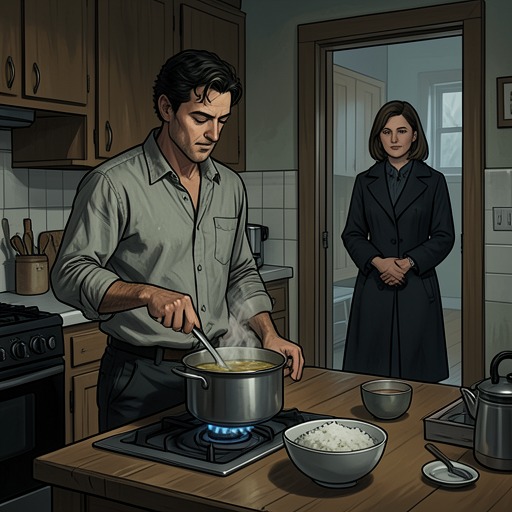
The baby octopus becomes the focus of a carefully described preparation. The narrator sorts the small creatures, about ten to a handful, and browns them with shallots, soy sauce, sugar, and diluted bean paste. She lowers the heat so they will not dry out, waits for the sauce to thicken, and adds sesame and slices of small sticky rice balls before turning to chop carrots. The sequence gives cooking its own precise order: ingredient, heat, texture, timing, and appearance all matter to her.
The work is interrupted when Yan Kerrand comes into the kitchen for water and watches her. Under his sustained gaze, the narrator loses concentration and cuts the palm of her hand. Blood wells onto the carrots and hardens into a brownish crust; Yan Kerrand takes out a handkerchief and holds it against the wound. The octopus dish is not simply background to this encounter: its preparation puts the narrator at work in a space where her movements can be observed, and the interruption makes that attention consequential in a small, physical way.
Octopus Among Other Foods
The story also places octopus within the broader demands of the mother’s fish trade and household cooking. At a meal near the port, the narrator’s mother discusses the late catch and says she needs Fugu for the coming Seollal meal, but that only octopus is available. This is a statement about supply, not a description of octopus being served at that meal. It gives the animal a place in the mother’s practical calculations: what the market can provide matters to the ritual meal she is planning.
The shortage is sharpened by the mother’s particular expertise. She is the only fishmonger in Sokcho licensed to prepare Fugu, whose organs contain lethal toxins and whose translucent flesh she can turn into an impressive dish. Octopus is not given the same elaborate treatment in this passage; it is the available catch against which the desired ingredient is measured. The contrast shows how the market’s ordinary supply and the mother’s specialist skill meet in her plans for Seollal.
Ink, Craft, and Artistic Attention
Later, the narrator is asked to purée an octopus. She cuts off its tentacles and reaches inside its head to remove the ink sac. As she works, she pictures Yan Kerrand at his desk, his lips pursed and his hand moving through the air before settling on the paper. She contrasts his apparent attention to the movements of wrist and hand with her own habit of holding the finished dish in mind as she cooks: its appearance, taste, and nutritional balance. The octopus is therefore part of a concrete task through which the narrator considers two different kinds of making.
The scene places that task beside her mother’s preparation of Fugu. Her mother removes the poisonous organs carefully, keeps them separate, and bags them before throwing them away; the narrator watches, having never been allowed to handle Fugu herself. While the mother works, she suddenly cries out about the ink. The exclamation brings attention back to the octopus the narrator is handling, but the scene does not spell out a larger consequence. Instead, the ingredient’s ink becomes a sharp point of contact between the two women’s work: one is managing dangerous organs with practiced control, while the other has been entrusted with removing an octopus’s ink sac.
Narrative Role
Octopus appears through repeated acts of handling rather than through an independent story of its own. It is bought, cooked, discussed as available market stock, and cut open for its ink. Those different circumstances keep the creature tied to the material routines of the narrator’s family and employment. The recurring attention to quantities, heat, texture, and bodily interiors makes food preparation visible as skilled labor rather than an incidental domestic detail.
Its appearances also help distinguish forms of care and authority. The mother supplies the baby octopus, plans around the catch, and exercises control over the preparation of Fugu; the narrator cooks and later works on the octopus, but is excluded from handling the dangerous fish. In the kitchen with Yan Kerrand, her careful cooking is briefly disrupted by being watched, while her later comparison of cooking and drawing turns the handling of the octopus into a way of noticing how differently each craft approaches its finished form. The creature’s narrative significance lies in this recurrence: it connects the market, the family kitchen, the narrator’s labor, and her reflections on making without ceasing to be a particular food that must be handled.